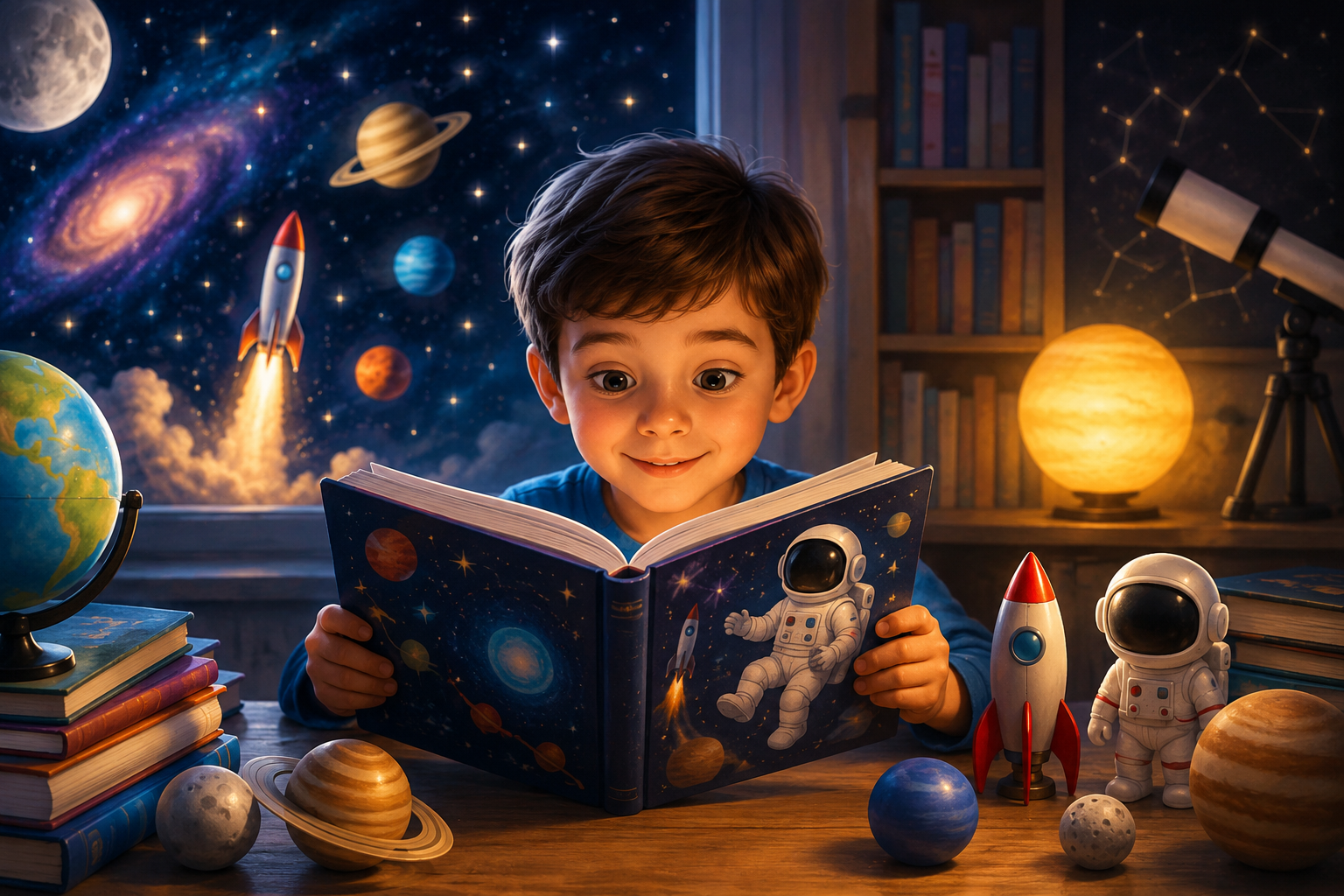
Space has always captured the imagination of children. The twinkling stars, mysterious planets, powerful rockets, and brave astronauts create a world full of wonder that encourages young minds to dream big. Whether a child is fascinated by the Moon, curious about distant galaxies, or simply loves exciting adventures, childrens books about space provide an excellent way to combine entertainment with education. These books transport readers beyond Earth’s atmosphere while introducing scientific concepts in a way that is engaging, age-appropriate, and easy to understand.
Reading is one of the most effective ways to nurture curiosity, and when children explore stories centered around space, they develop a deeper appreciation for science, creativity, and discovery. Instead of viewing astronomy as a complicated subject, they begin to see it as an exciting journey filled with endless possibilities. A well-written space book can inspire children to ask questions, think critically, and imagine futures where they become astronauts, scientists, engineers, or explorers.
In today’s world, where STEM education is becoming increasingly important, introducing children to the wonders of the universe through books is more valuable than ever. Stories about space encourage both learning and imagination, making them a favorite choice among parents, teachers, and young readers alike.
Why Children’s Books About Space Are So Popular
There is something magical about the unknown, and space represents the greatest mystery humanity has ever explored. Children naturally wonder what lies beyond the clouds, why stars shine at night, or whether life exists on other planets. Childrens books about space answer these questions while leaving room for imagination, making every reading experience exciting and memorable.
Unlike many educational topics, space instantly captures attention because it combines real science with endless possibilities. A child can learn about gravity on one page and imagine traveling through the Milky Way on the next. This perfect balance between fact and fantasy keeps young readers engaged while helping them absorb new information without feeling overwhelmed.
Parents also appreciate space-themed books because they encourage curiosity outside the classroom. After reading about planets or astronauts, children often become interested in observing the night sky, visiting science museums, or learning more about the latest discoveries in astronomy. These books become the starting point for conversations that extend far beyond the final page.
How Space Books Encourage a Love of Reading
Developing strong reading habits begins with choosing subjects that genuinely interest children. For many young readers, few topics are as exciting as space. The combination of colorful illustrations, adventurous storytelling, and fascinating scientific facts keeps children motivated to continue reading.
When children become emotionally invested in stories about courageous astronauts, friendly aliens, or adventurous space explorers, they naturally improve their reading comprehension and vocabulary. Instead of reading because they have to, they begin reading because they want to know what happens next. This shift creates positive reading habits that often continue throughout childhood.
Books about space also introduce children to new words related to science and astronomy. Terms like galaxy, orbit, constellation, gravity, and telescope become familiar through context, helping children expand their vocabulary while learning about the universe. This natural approach to language development makes reading both educational and enjoyable.
The Educational Benefits of Children’s Books About Space
One of the greatest strengths of childrens books about space is their ability to make complex scientific concepts accessible. Rather than presenting astronomy through difficult explanations, these books introduce ideas through engaging stories, relatable characters, and beautiful illustrations that simplify learning.
Children gradually begin to understand how the solar system works, why planets orbit the Sun, what causes day and night, and how astronauts live in space. These concepts become easier to remember because they are connected to memorable adventures and imaginative storytelling. Young readers often don’t realize they are learning science because they are fully immersed in the story itself.
Space books also encourage critical thinking. As children read about space exploration, they naturally begin asking questions about how rockets launch, why gravity changes in space, or what it might be like to visit Mars. This curiosity helps develop analytical thinking skills that benefit them across many areas of education.
Perhaps most importantly, these books inspire a lifelong appreciation for learning. Children discover that science is not just something found in textbooks but something that explains the incredible world—and universe—around them.
Exploring the Solar System Through Storytelling
For many children, their first introduction to astronomy begins with learning about the planets. Stories that take readers on adventures across the solar system help them understand the unique characteristics of each planet while making the information exciting and memorable.
Children quickly discover that Mercury is the closest planet to the Sun, Venus is covered with thick clouds, Earth is our home, and Mars has inspired dreams of future exploration. As stories continue, they encounter the enormous storms of Jupiter, the beautiful rings of Saturn, the icy landscapes of Uranus, and the deep blue beauty of Neptune.
Instead of simply memorizing facts, children imagine traveling from one planet to another alongside adventurous characters. This storytelling approach transforms the solar system into an exciting destination filled with discoveries waiting to be made.
These imaginative journeys help young readers develop a stronger understanding of astronomy while encouraging them to continue exploring scientific topics independently.
Sparking Creativity Through Space Adventures
While educational value is important, one of the greatest gifts offered by childrens books about space is their ability to inspire creativity. Space has no visible boundaries, allowing authors and illustrators to create limitless adventures that stretch the imagination.
Children often imagine discovering new planets, meeting friendly alien civilizations, building futuristic spacecraft, or becoming astronauts on missions beyond our galaxy. These creative scenarios encourage problem-solving, storytelling, and artistic expression while helping children think beyond everyday experiences.
Creative thinking is an essential life skill that extends far beyond reading. Children who regularly engage with imaginative stories become more confident in expressing ideas, solving challenges, and approaching problems from different perspectives. Space-themed books provide the perfect environment for this type of creative development because the possibilities truly are endless.
Even after closing the book, children frequently continue their adventures through drawings, pretend play, creative writing, or conversations with family and friends. The story becomes the beginning of an even larger journey fueled by imagination.
How Space Books Support STEM Education
Science, Technology, Engineering, and Mathematics commonly known as STEM play an increasingly important role in modern education. Fortunately, childrens books about space introduce these subjects in a way that feels exciting rather than intimidating.
As children read about rockets, satellites, astronauts, and space exploration, they begin to understand how engineering and technology make these incredible achievements possible. They learn that scientific discoveries are made through curiosity, experimentation, teamwork, and perseverance.
Stories about real and fictional space missions also demonstrate the importance of problem-solving. Whether characters are repairing a spacecraft, navigating through an asteroid field, or conducting scientific experiments aboard a space station, children witness how knowledge and cooperation lead to success.
These lessons help young readers develop an early interest in STEM careers while showing them that science can be both fascinating and fun. Many scientists, engineers, and astronauts have shared that their passion for exploration began with childhood books that encouraged them to dream beyond Earth’s atmosphere.
The Importance of Beautiful Illustrations in Space Books
Illustrations play a significant role in helping children understand concepts that cannot easily be seen in everyday life. Since most children have never visited space, artwork becomes their window into the universe.
Talented illustrators create breathtaking images of colorful nebulae, sparkling stars, towering rockets, distant planets, and floating astronauts that bring each story to life. These visuals help children imagine the enormous scale of the universe while making abstract scientific ideas easier to understand.
For younger readers especially, illustrations provide context that supports reading comprehension. Even before children can read independently, they begin learning through pictures that explain what words cannot fully describe. As they grow older, these visual experiences strengthen both imagination and understanding.
The combination of engaging storytelling and captivating artwork ensures that space books remain memorable long after they have been read.\
Why Representation and Diversity Matter in Space Stories
Modern childrens books about space increasingly feature diverse characters from different cultures, backgrounds, and experiences. This representation helps every child see themselves as future explorers, scientists, engineers, or astronauts.
When children read stories featuring boys and girls working together to solve problems, explore new worlds, or make important discoveries, they begin believing that they too can achieve great things. Inclusive storytelling sends a powerful message that curiosity, intelligence, and determination are qualities anyone can possess.
Books that celebrate teamwork and collaboration also teach children that space exploration is never the work of one individual. Scientists, engineers, pilots, mathematicians, and countless other professionals work together to accomplish extraordinary goals. These lessons help children understand the importance of cooperation, communication, and respect for others.
The Lasting Impact of Children’s Books About Space
Many adults can remember a childhood book that inspired their love of science or sparked dreams of becoming an astronaut. Stories have a remarkable ability to influence children’s interests, shape their ambitions, and encourage them to see the world differently.
Space-themed books often leave a lasting impression because they combine wonder with possibility. They remind children that there is still so much left to discover and that every great scientific achievement began with someone asking a simple question. Whether a child eventually becomes a scientist, engineer, teacher, artist, or writer, the curiosity inspired by these books continues to benefit them throughout life.
Reading also strengthens essential skills such as concentration, comprehension, vocabulary, and critical thinking. When these educational benefits are combined with exciting adventures across the universe, children develop both academically and personally.
The Future of Space Literature for Young Readers
As space exploration continues to evolve, so will the stories written for young readers. New missions to the Moon, Mars, and beyond are creating exciting opportunities for authors to introduce children to the latest discoveries in astronomy and technology. Future childrens books about space will likely explore topics such as reusable rockets, space tourism, robotic exploration, artificial intelligence, and the search for life beyond Earth.
Advances in publishing have also made space books more interactive than ever before. Many modern titles include augmented reality features, online learning resources, and engaging activities that allow children to explore the universe in new ways. These innovations make reading even more immersive while maintaining the educational value that parents and teachers appreciate.
Despite these technological changes, the heart of every great space book remains the same. Inspiring curiosity, encouraging imagination, and helping children dream beyond the stars will always be the foundation of memorable stories.
Conclusion
The universe is one of the greatest sources of inspiration a child can experience, and childrens books about space open the door to that incredible adventure. They do much more than teach children about planets, stars, rockets, and astronauts. They encourage imagination, strengthen reading skills, introduce important STEM concepts, and inspire young minds to ask questions about the world around them.
Whether shared during bedtime, enjoyed in the classroom, or explored independently, these books create meaningful learning experiences that stay with children for years. Through engaging storytelling, beautiful illustrations, and age-appropriate scientific information, they transform complex ideas into exciting adventures that readers can understand and enjoy.
As children turn each page, they discover that the universe is full of endless possibilities waiting to be explored. They learn that curiosity leads to discovery, imagination fuels innovation, and every great explorer once began as a child with a dream. By introducing young readers to the wonders of the cosmos, childrens books about space inspire a lifelong love of learning while reminding them that no dream is too big when they are willing to reach for the stars.
Start your childs space adventure today with captivating children’s books about space that make learning fun and unforgettable.