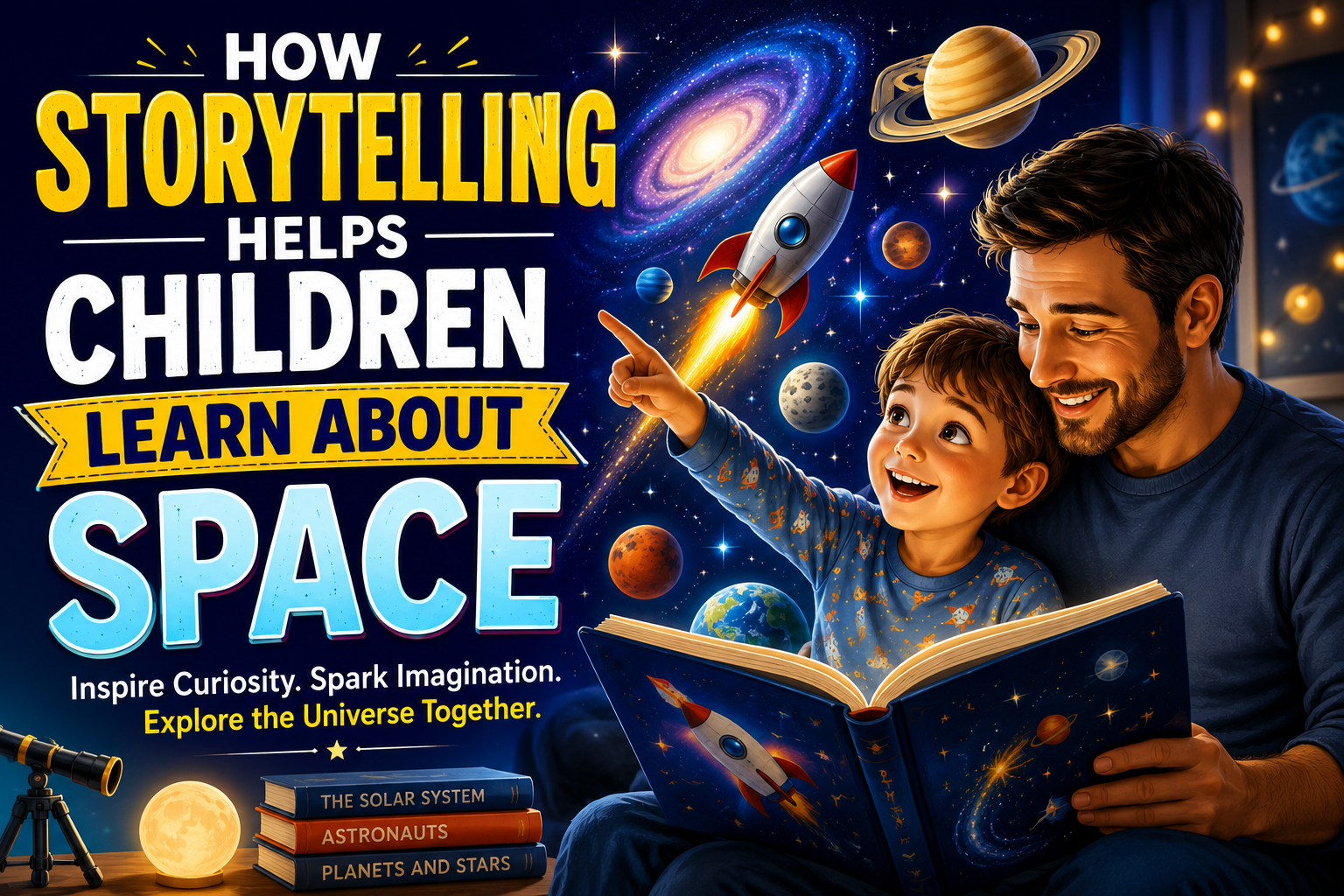
Space has fascinated children for generations. The stars, planets, galaxies, and endless mysteries of the universe naturally spark curiosity in young minds. While documentaries, classroom lessons, and science experiments all play an important role, storytelling remains one of the most powerful ways to introduce children to the wonders of space.
Understanding how storytelling helps children learn about space reveals why books continue to be one of the best educational tools for young readers. A well-crafted story transforms scientific facts into exciting adventures, allowing children to imagine themselves traveling among the stars while learning about the solar system, astronauts, and the universe in an engaging and memorable way.
Whether read at bedtime, in the classroom, or during family reading time, space-themed stories encourage children to dream big while building valuable knowledge that lasts a lifetime.
Why Storytelling Is a Powerful Learning Tool
One of the biggest reasons how storytelling helps children learn about space is so effective is because stories naturally capture a child’s attention. Instead of presenting facts as information to memorize, stories create emotional connections that make learning enjoyable.
When children follow a character on an exciting journey through space, they become emotionally invested in what happens next. Every planet visited and every challenge overcome becomes part of an unforgettable adventure.
Stories also encourage active imagination. Instead of simply hearing that Saturn has rings or Jupiter is the largest planet, children visualize these worlds through descriptive storytelling. This combination of imagination and education strengthens memory and improves understanding.
How Storytelling Helps Children Learn About Space Through Imagination
Imagination is the foundation of creativity and problem-solving. One of the greatest benefits of how storytelling helps children learn about space is that it encourages children to imagine possibilities beyond Earth.
Children picture themselves:
- Flying a spaceship.
- Visiting distant planets.
- Meeting friendly aliens.
- Exploring mysterious galaxies.
- Becoming astronauts.
These imaginative experiences make scientific concepts feel exciting rather than overwhelming.
Instead of asking children to memorize the order of the planets, stories naturally introduce each destination as part of an adventure. Learning becomes something they experience instead of simply reading.
Space Stories Make Science Easier to Understand
Science can sometimes feel difficult for young learners. Storytelling simplifies complex concepts by placing them within familiar situations.
For example, instead of explaining gravity using scientific terminology, a story can show how astronauts float inside a spacecraft.
Instead of listing facts about Mars, a story may describe a child landing on the red planet and discovering its rocky surface.
This is one of the clearest examples of how storytelling helps children learn about space because children understand ideas through experiences rather than definitions.
Stories create context, making scientific knowledge easier to remember.
How Storytelling Helps Children Learn About Space and Build STEM Skills
Many parents look for ways to introduce STEM (Science, Technology, Engineering, and Mathematics) at an early age.
One effective method is through storytelling.
Books that combine adventure with science encourage children to ask questions like:
- Why do rockets fly?
- How do astronauts breathe in space?
- Why do planets orbit the sun?
- Could humans live on another planet?
These questions naturally develop scientific thinking.
As children search for answers, they begin building analytical skills, curiosity, and confidence in learning science.
This demonstrates exactly how storytelling helps children learn about space while preparing them for future STEM education.
The Role of Space-Themed Books in Early Childhood Education
Reading space-themed books introduces children to new vocabulary while expanding their understanding of the universe.
Words like:
- Galaxy
- Orbit
- Astronaut
- Telescope
- Gravity
- Meteor
- Constellation
- Solar System
become familiar through repeated exposure in stories.
Unlike textbooks, storybooks present these terms in meaningful contexts, helping children understand their definitions naturally.
As a result, children improve both literacy and scientific knowledge at the same time.
Learning Through Adventure Creates Lasting Memories
Children remember experiences far better than isolated facts.
This is why adventures remain memorable for years.
When a young character travels from Mercury to Neptune, each destination becomes part of an exciting journey.
Every challenge solved along the way helps reinforce scientific concepts.
Adventure-based storytelling creates emotional memories that improve long-term learning.
This is another important reason how storytelling helps children learn about space is so effective for young readers.
Books Like Commander Adam and the Spaceship Bring Space to Life
Books such as Commander Adam and the Spaceship perfectly demonstrate how storytelling helps children learn about space.
Instead of presenting the solar system as a classroom lesson, the story transforms it into an unforgettable adventure between a father and son.
Young readers travel through space, discover planets, and imagine themselves as explorers while learning valuable scientific concepts in a fun and engaging way.
Stories like these encourage children to ask questions, dream about future discoveries, and develop a lifelong interest in science.
Rather than simply reading about space, children feel as though they are part of the journey.
Storytelling Encourages Family Learning
One of the greatest strengths of children’s books is that they create opportunities for families to learn together.
Parents can pause during reading to ask questions like:
- Which planet would you visit?
- Why do you think astronauts wear helmets?
- What do you think life in space would be like?
These conversations strengthen comprehension while creating meaningful family moments.
Shared reading also builds communication skills, confidence, and curiosity.
When children discuss stories, they process information more deeply than when reading alone.
Space Stories Inspire Big Dreams
Today’s readers become tomorrow’s scientists, engineers, astronauts, and innovators.
Many professionals working in science first developed an interest through books they read as children.
By showing young readers exciting adventures beyond Earth, storytelling inspires them to believe anything is possible.
A simple bedtime story may become the first step toward a lifelong passion for astronomy or space exploration.
That is the true power behind how storytelling helps children learn about space.
How Parents Can Make Space Stories Even More Educational
Parents can extend learning beyond the pages of a book by combining storytelling with simple activities.
After reading together, children can:
- Draw their favorite planet.
- Build a paper rocket.
- Create their own solar system model.
- Watch the night sky.
- Learn interesting facts about astronauts.
- Write their own space adventure.
These activities reinforce concepts introduced through storytelling while making learning interactive and enjoyable.
The Future of Learning Through Stories
As technology evolves, storytelling continues to remain one of the most effective educational methods.
Digital books, audiobooks, and interactive reading experiences are expanding how children discover science.
However, the core principle remains the same.
Children learn best when education feels like an adventure.
Whether through printed books or digital stories, storytelling continues inspiring imagination, curiosity, creativity, and lifelong learning.
For parents seeking enjoyable educational resources, space-themed storybooks remain among the best choices available.
Conclusion
Understanding how storytelling helps children learn about space highlights why stories remain one of the most valuable educational tools for young readers. By blending imagination with scientific concepts, storytelling transforms complex ideas into exciting adventures that children can easily understand and remember.
Space-themed books encourage curiosity, strengthen literacy, introduce STEM concepts, and inspire children to dream beyond the stars. Stories such as Commander Adam and the Spaceship demonstrate how an engaging adventure can spark a lifelong love of science while creating meaningful family reading experiences.
When children see themselves exploring planets, navigating spaceships, and discovering the mysteries of the universe, they are not just reading—they are building confidence, creativity, and a passion for learning that can last a lifetime.
Ready to inspire your child’s imagination and curiosity about the universe? Discover Commander Adam and the Spaceship